

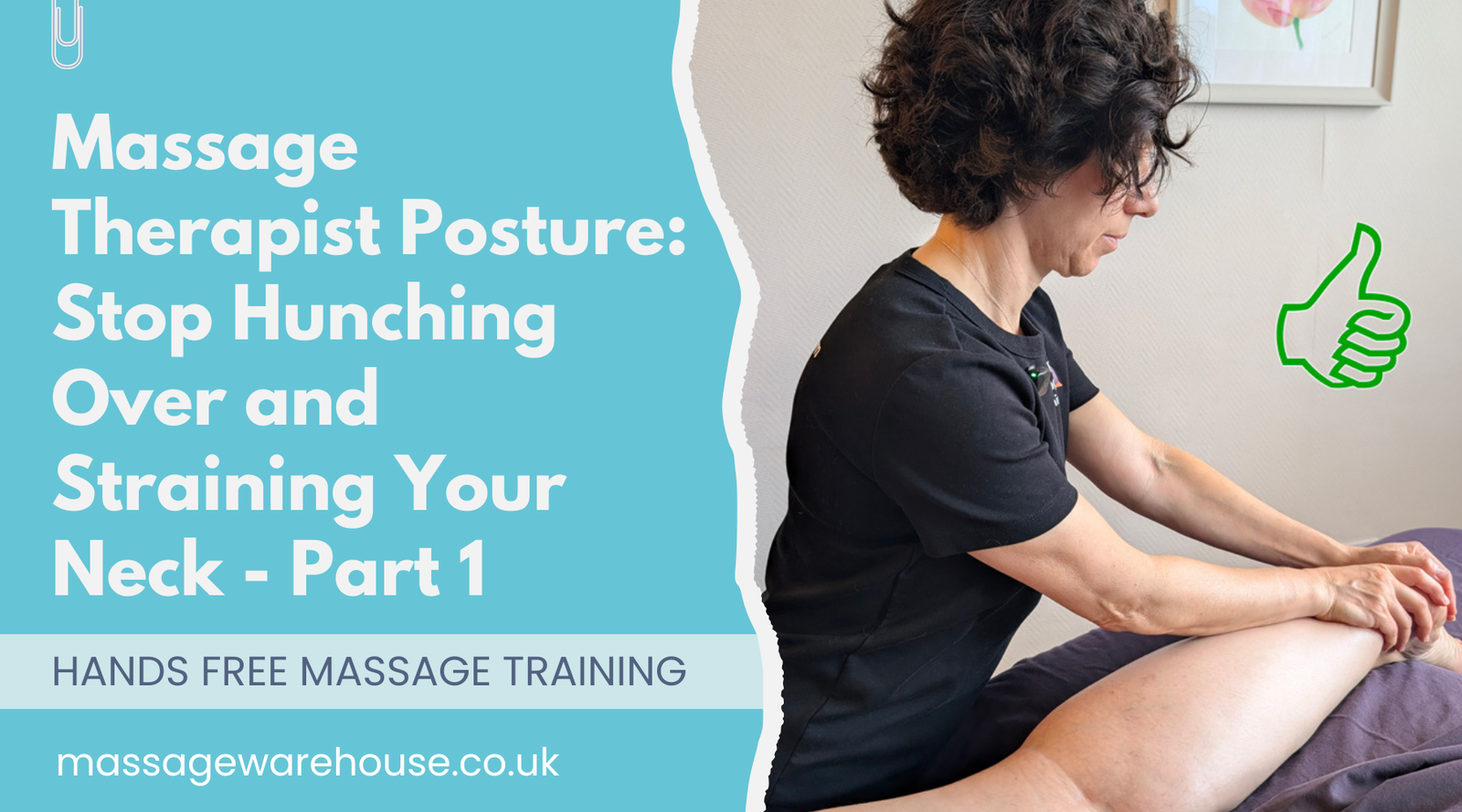
Massage therapist posture: Stop hunching over and straining your neck - Part 1

Massage therapist posture: Stop hunching over and straining your neck - Part 1


What you do with your neck, head and face/eyes while you massage matters. The way you hold your head can affect the way you use the rest of your body. Holding your head at peculiar angles or craning down will impact your body mechanics and cause you strain.

In our next 4-post bumper edition, about what you do from the shoulders up, we look at common habits of massage practitioners that can cause problems in relation to the neck, head and face.

Part 1:Dropping your head to watch your working hands, which often leads to hunching over

Part 2: How to avert your eyes and still move fluidly while you massage

Part 3:The face and jaw, and the tension we might carry there, while massaging

Part 4:Self-care tips for releasing your neck & moving more fluidly while you massage

Let’s start now with a common habit of looking at your hands while you massage

Watching your hands or forearms while you are learning massage

When we are first learning to do massage, we need to look carefully at what we are doing with our hands. As we develop greater sensitivity through our hands, we become better at feeling our way through the massage. We need to strive toward not keeping our eyes fixed on our hands. This frees our head and neck to stay more well aligned with our spine and body or allows it to move fluidly.

If you learn Hands Free Massage, this process of learning not to look at what we are doing can take a little longer, while we develop sensitivity and awareness through our forearms and elbows.

Often, when we are teaching Hands Free Massage, we find that our learners have another ingrained long-term habit which we help them to overcome: a propensity for the neck and head to lean to the side. Through our coaching, we aim to help them become aware of this pattern and discover how allowing the head and neck to move more freely can improve the way their whole body works.

Whether massaging with hands or forearms/elbows, looking down at what we are doing can remain a strong habit which remains long after we have developed enough sensitivity and no longer need to watch so closely.

Hunching over while you massage

Initially, many of us look at our hands by dropping our head, which causes us to hunch over and impedes the transmission of power from the lower body. This can lead to overusing your shoulder and arm muscles and can cause you to stiffen the head, neck and back.

Unless this posture is addressed, it can become an unconscious fixed habit, leading to shoulder and back problems; see images 1 and 2.

Tall practitioners need to be especially careful about this, because hunching over can already be a habit for them. It is also a common problem for visually impaired massage practitioners, who are accustomed to hunching over to move their eyes close to objects for maximum visual input.

Don’t worry, we are not the only profession; Dropping the head down is also an occupational hazard in many others, for example, dentists and hairdressers.

As you become practised at your massage, you can learn to make the necessary adaptations. To get your head close to what you are doing, you could bend your knees and, if necessary, also widen your stance. This enables you to lean with your whole trunk so that your neck and head stay pretty much in line with your back; see images 3 and 4.

Images 1 & 2: Watching the hands, dropping the head

dropped head 

Image 2: Hunching over

hunched over


Images 3 & 4: 
Leaning with the trunk 

lean
lean

If hunching over is an ingrained habit, you may need to receive deep tissue massage treatments and do some yoga, or Pilates, Feldenkrais or Alexander work to help change your posture.

Holding the head stiffly - a life habit

There is another common habit associated with using your eyes. Sportspeople and dancers get used to focusing while they are moving. However, so much of our modern life involves holding the head still while using the eyes, for example, looking at computer screens or TVs while sitting in static positions; Tech Neck it’s now called. And let’s not get started on what angles necks and backs are at when using their phones! Many people come to massage sessions with the unconscious habit of stiffening the neck (and often the rest of the trunk) when using their eyes.

In summary

Watching your hands is a natural and necessary part of learning massage and many daily habits, but as your sensitivity and confidence develop with your massage, you can begin to let your eyes and hands work more independently. Otherwise, dropping your head to watch your work can become an unconscious habit, leading to hunching, tension and less efficient use of your whole body.

It’s also worth noticing what happens to your head, neck and jaw when you use your eyes.Do they remain relaxed and mobile, or do they become stiff and fixed as you concentrate?

In Part 2, we’ll look at some tips for using your eyes in different ways and keeping a fluid motion while you massage.

This article is excerpted from Dynamic Bodyuse for Effective, Strain-Free Massage (Lotus Publishing, 2008), to be republished in a new edition Delivering Effective, Strain-Free Massage in 2026.


About the Authors

Darien Pritchard from Dynamic Massage and Hands Free Massage Training, has been a massage trainer since 1982, and has served on the General Council for Massage Therapy (UK). He wrote the career-maintenance book Dynamic Bodyuse for Effective Strain-Free Massage (2008), and the student text Anatomy, Physiology and Pathology for Massage (2nd ed, 2023). For four decades, Darien has pioneered a focus on how massage practitioners can protect their hands and body whilst using them most effectively, including developing the original Hands Free Massage training 25 years ago - the skilful, sensitive use of the forearm and elbow to save the hands.

Leora Sharp from Hands Free Massage Training, has been a massage practitioner since 2008 and very early on in her career, realised the importance of needing to work as Hands Free as possible. To that end, in 2009 she trained with Darien and was so blown away with Hands Free Massage, that she offered to assist him on his 8 Day Advanced training. Her role slowly transformed into co-teacher and she then started teaching solo in 2016. She is continually bowled over how amazing HFM is and the benefits it brings to practitioners to sustain their careers. Alongside teaching HFM, Leora has a private practice at Neal’s Yard in Bath and designs websites for complementary health professionals.


Also in Massage Warehouse Blog

The “Refer-a-Friend” Scheme That Actually Works For Massage Therapists

September 21, 2026 6 min read 0 Comments

Learn how massage therapists can attract new clients and grow their massage business with a simple “Recommend a Friend” strategy designed to turn trusted client relationships into personal referrals.

Read More
Bookkeeping for Massage Therapists: Build Better Habits

August 11, 2026 6 min read 0 Comments

Bookkeeping can be easy to put off when you’re busy seeing clients. Discover simple habits to help massage therapists stay organised, track expenses and feel more in control of their massage business finances.

Read More
How UK Massage Therapists Are Really Surviving the Heatwave!

July 28, 2026 7 min read 0 Comments

How are massage therapists coping with the UK heatwave? We asked our therapist community to share their best tips for staying cool, keeping clients comfortable, and working safely through hot weather. From portable air conditioning and cooling massage products to hydration, scheduling changes and treatment room hacks, discover practical advice from real massage therapists that you can start using today.

Read More