

February 26, 2026 5 min read
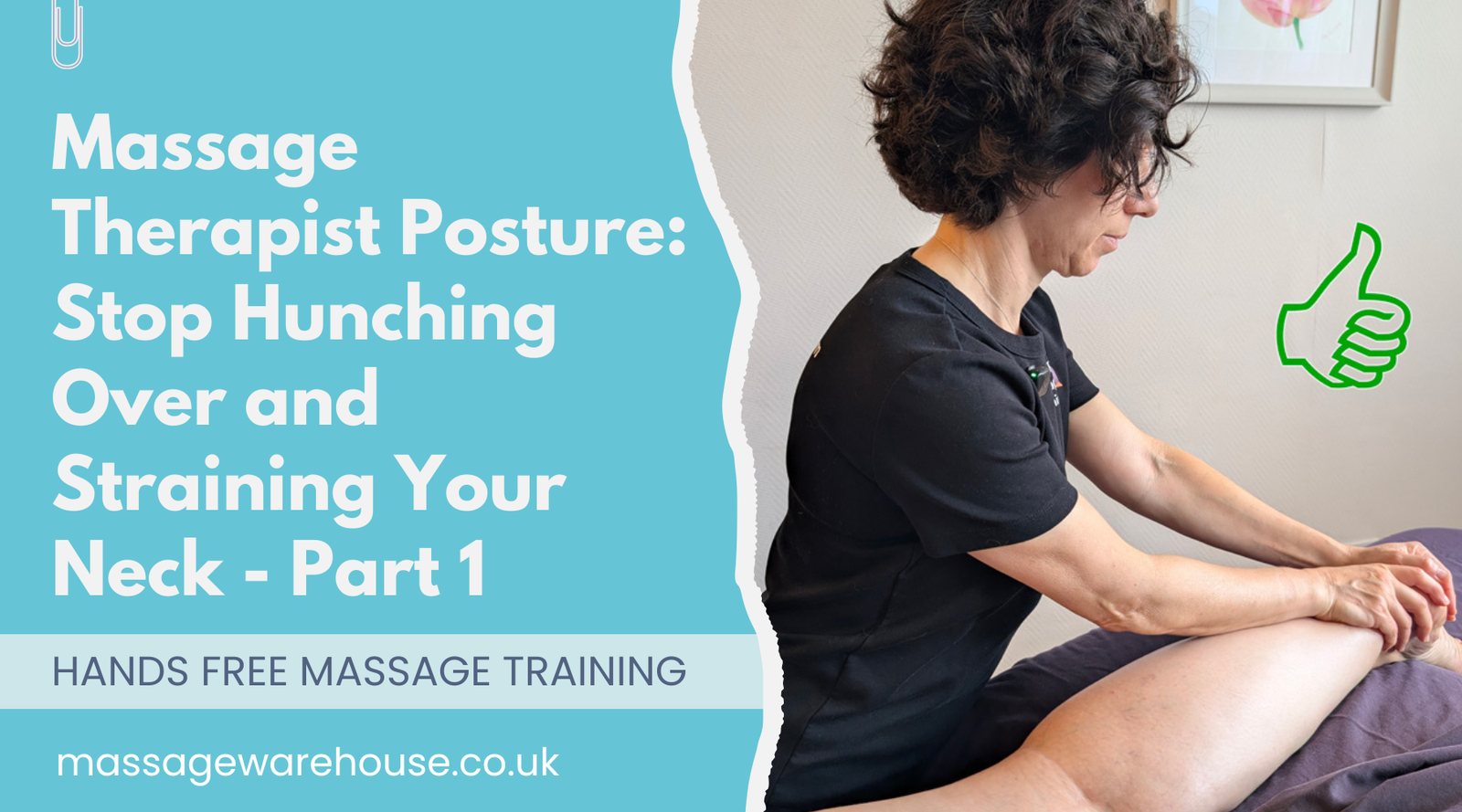
0 CommentsA major cause of early retirement from our profession is the cumulative strains that can develop from each massage.
The growth of the profession in recent decades has been accompanied by an increase in work-induced problems. Practitioners can strain their hands, particularly their thumbs and wrists, and also their shoulders and backs.
Our hands and body are the tools of our trade, so it’s essential to look after them.
In this 3-part series, we hope to draw your attention to various potential problems and to offer you alternative ways of working to reduce the strains on your hands and body, and therefore helping you to sustain your career.
Part 1 - Applying pressure & the resulting strain
Part 2 - Common stages in the development of fatigue, aches, strain and pain
Part 3 - Working most effectively with the least amount of strain
How to apply pressure without straining your body or damaging your hands is the greatest physical challenge in professional massage.
Doing a firm massage requires you to apply compressive pressure consistently through all of the joints of your upper limbs, from your shoulders down to your digits.
Newton’s Third Law of Motion states that: “For every action there is an equal and opposite reaction”.
If we apply this idea to massage, this means that the amount of pressure that we apply on/to the client is the same as the amount of pressure that you are sending back up through your hands, arms and shoulders.
The amount of pressure that we apply during a single massage session can easily be the equivalent of pushing a small car for a few minutes.
So the pressure that we potentially apply in a working day (assuming that is 4-5 clients) could be the equivalent of pushing that car for 20-30 minutes. Imagine that! Sounds like part of an Ironman competition doesn't it?!
We need to bear this in mind when we look at how to work so that we can deliver pressure most effectively without straining our bodies.
It’s particularly important to pay attention to:
Even if you have a large or strong build, it’s useful to think about how to conserve your body and hands.
Do you have an average build? You’ll need to be more careful with your hands and body, monitoring yourself as you work and maybe making changes in the way that you work.
Do you have small or slender build or hypermobile joints? Then you need to be EXTRA CAREFUL because you are more at risk of straining your hands and body.
It’s crucial that you think about how to tailor your work to conserve yourself.
And for clients who want more pressure than you can comfortably deliver, it would be wise to refer them on. In this regard, it is handy to have a list of trusted practitioners to refer to.
Putting pressure on your body or working awkwardly in a single massage session will probably not fatigue or strain your body.
However, regularly working awkwardly while applying pressure or regularly applying more pressure than your body can comfortably handle will put you at risk of developing strain in your hands and body, as it does in other fields. For example, people who use computers for most of the day often type with their wrists bent back and then there's the clicking of the mouse. They are at risk of developing RSI/repetitive strain injury. And a jogger who runs awkwardly will not last any great distance.
So it’s the slow accumulation of strain over time that can affect you.
Because the pressure that you apply is spread throughout each session, small strains can build up slowly, often outside of your awareness.
You may only notice the effects, such as feeling tired, stiff, achey or in pain when it has accumulated over time. However, if small discomforts are not addressed, they can accumulate and lead to long-term strain and damage, and this could end your career early.
In the past, we have heard of teachers telling students to expect aches and pains from doing massage because it “just comes with the territory”. These days, massage is definitely shifting away from that idea, but that attitude is a road to burnout and physical damage to your body.
So, if you feel strains developing, take them as EARLY WARNINGS and change the way that you work before you physically burn out.
It’s no use to your clients if you damage your body and are unable to continue massaging. It’s a waste of your skills if your career is cut short. And these work-related strains can debilitate you in your daily life, too.
Applying pressure is not just a technical skill; it’s a full-body, cumulative load that you carry every single day you work. When we zoom out and really consider the forces involved, it becomes clear why how you apply pressure matters just as much as how much pressure you apply.
The key takeaway from Part 1 is this: strain rarely comes from one massage, one client, or one “bad day.” It builds quietly, session by session, often beneath your awareness, until your body eventually asks you to stop, sometimes loudly. Your build, joint stability, working habits, and willingness to adapt all play a role in whether your career feels sustainable or slowly draining.
Aches and fatigue are not badges of honour, and they are certainly not inevitable. They are information. Early signals invite you to refine your technique, rethink your working patterns, and protect the very tools your livelihood depends on.
In the next parts of this series, we’ll explore how strain typically develops over time, how to recognise the early stages before pain takes hold, and most importantly, how to work in ways that allow you to deliver effective pressure with less effort and greater longevity.
Your body deserves that care just as much as your clients do.
This article is excerpted from Dynamic Bodyuse for Effective, Strain-Free Massage(Lotus Publishing, 2008), to be republished in a new edition, Delivering Effective, Strain-Free Massage in 2026.
Read Part 2 here: Common Stages in the Development of Fatigue, Aches, Strain and Pain.
Read part 3 here: Working Most Effectively with the Least Strain.
About the Authors
Darien Pritchard from Dynamic Massage and Hands Free Massage Training, has been a massage trainer since 1982, and has served on the General Council for Massage Therapy (UK). He wrote the career-maintenance book Dynamic Bodyuse for Effective Strain-Free Massage (2008), and the student text Anatomy, Physiology and Pathology for Massage (2nd ed, 2023). For four decades, Darien has pioneered a focus on how massage practitioners can protect their hands and body whilst using them most effectively, including developing the original Hands Free Massage training 25 years ago - the skilful, sensitive use of the forearm and elbow to save the hands.
Leora Sharp from Hands Free Massage Training, has been a massage practitioner since 2008 and very early on in her career, realised the importance of needing to work as Hands Free as possible. To that end, in 2009 she trained with Darien and was so blown away with Hands Free Massage, that she offered to assist him on his 8 Day Advanced training. Her role slowly transformed into co-teacher and she then started teaching solo in 2016. She is continually bowled over how amazing HFM is and the benefits it brings to practitioners to sustain their careers. Alongside teaching HFM, Leora has a private practice at Neal’s Yard in Bath and designs websites for complementary health professionals.

June 03, 2026 5 min read 0 Comments
If your massage therapy business relies entirely on social media, you could be one suspended account away from losing everything. When it happened to me, I wasn't panicking because I'd already built the foundations that most therapy businesses are missing. Here's what I learned, and the three things every massage therapist should do this week to protect their business for good.

April 20, 2026 6 min read 0 Comments
Thumb pain, wrist strain, aching shoulders - sound familiar? In Part 3 of our series, we look at the areas massage therapists most commonly injure, and the simple body mechanic adjustments that can protect your hands and extend your career.

April 14, 2026 5 min read 0 Comments
Most massage therapists wait until January to think about tax. Here's why doing it now in April could save you time, stress, and money, with a simple checklist to get your records straight while it's all still fresh.