

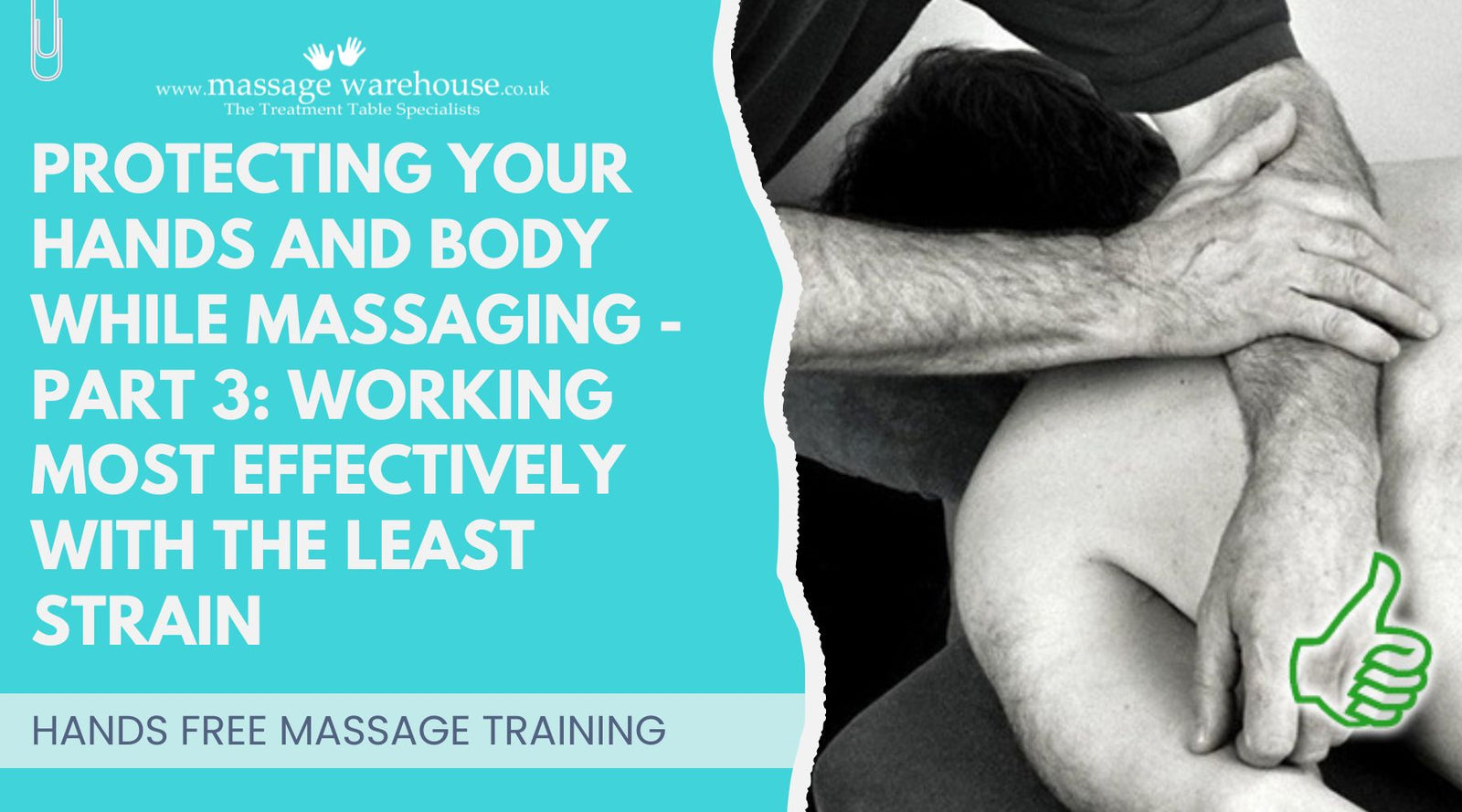

Protecting Your Hands and Body While Massaging - Part 3: Working Most Effectively with the Least Strain

Protecting Your Hands and Body While Massaging - Part 3: Working Most Effectively with the Least Strain

In Part 1 of this series, we discussed applying pressure and possible resulting strain, and in Part 2 we examined the development of strain and pain and some solutions.

Now we move to looking at working smarter, not harder, addressing the commonest areas of strain so you can keep an eye out while you work.

The ideal in massage is to learn and work with the twin aims of being most effective with the least strain on your hands and body.

It’s crucial to focus on:

- protecting your hands while delivering pressure, particularly your thumbs and wrists
- using your body effectively to support the work of your hands. Think about this as; how can I deliver power from my body in order to save my shoulders and back.


The aim is to work smarter and easier(not harder), so that you can maintain your career with your hands and body intact - rather than burning out and perhaps irrevocably straining parts of your body.

When we teach Hands Free Massage we always use the saying; minimum effort, maximum effect™. This really is the best way forward.

Commonest areas of strain

To conclude our 3 part series, we look at:

- four areas that massage practitioners most commonly strain 

- ways of working that can cause fatigue or strain in these areas over time, especially when applying stationary pressure or adding pressure to sliding strokes

- alternative ways of working to reduce these strains

Hands

It’s important to protect your hands, particularly the most vulnerable parts - your thumbs and wrists (the areas that massage practitioners most commonly strain). Problems arise in both of these areas from regularly applying pressure with them bent back.

Thumb (base of thumb)

The area that massage practitioners most commonly strain is the base of the thumb - the CMC/carpo-metacarpal joint (where the thumb comes off the hand ). This strain most often arises from regularly applying pressure with the thumb bent back (hyperextended).

bent thumbs
Fig. 1 – Applying pressure with thumb(s) bent back.

Supporting thumb with the rest of hand
Fig. 2 – Supporting thumb with the rest of hand.

Wrapping other hand  around to support thumb
Fig. 3 – Wrapping other hand around to support thumb.


Using the elbow with care & precision
Fig. 4 – Using the elbow with care & precision.


If you feel that you need to apply pressure through your thumb, try:
- keeping your thumb straight
- supporting it with the rest of your hand
- wrapping your other hand around it for support

And you can save your thumbs (and the rest of your body) by learning to use your forearms and elbows with experienced Hands Free Massage Trainers. We love to teach practitioners to use these fab ‘tools’ with skilful and sensitivity™.

Wrist

This is the second most at-risk area in massage. Your wrists, too, are most often strained by applying pressure with them bent back (or, less often, bent at other angles).

Applying pressure with the wrist bent back

Fig. 5 - Applying pressure with the wrist bent back.

Hand around the wrist to support it

Fig. 6 - Hand around the wrist to support it.


Supporting hand under the wrist

Fig. 7 - Supporting hand under the wrist.

Using the forearm with care & precision

Using the forearm with care & precision

To reduce the strain on your wrist:
- support around your wrist with your other hand
- or have your other hand underneath to support your wrist
- or save your wrist by learning to use your forearm skilfully (Hands Free Massage).

Body

It’s important to save your shoulders and back by positioning and moving your body to support your hands in action - rather than standing still and relying on your shoulder muscles.

Shoulders

The commonest causes of shoulder strain are:
- standing still and relying on shoulder muscle power
- tensing your shoulders to apply pressure
- trying to reach too far without moving your body
- or when the table is too high, which will force you to just work from your shoulders

Staying still and relying on shoulders

Fig. 9 - Staying still and relying on shoulders.

Tensing shoulders

Fig. 10 - Tensing shoulders.

Trying to reach too far

Fig. 11 - Trying to reach too far.

Hunching over
Fig. 12 - Hunching over.

Swaying whole body - great!
Fig. 13 - Swaying whole body - great!


The back (particularly the lower back)

Standing still and relying on your shoulder muscles for power also puts pressure on your lower back. So does hunching over, or trying to reach further than is comfortable.

Instead lean your body forward to deliver pressure, and sway your body forward and back for sliding strokes.

The take away

Working most effectively with the least strain is a skill that can be learned, refined, and embodied over time. It’s not about sacrificing depth or effectiveness; it’s about organising your hands and body so that power is delivered efficiently, safely, and sustainably.

By protecting vulnerable areas such as your thumbs and wrists, and by allowing your body weight and movement to support your work, you reduce unnecessary effort in your shoulders and back. Small adjustments in how you stand, lean, sway, and make contact can dramatically reduce fatigue and strain across a working day.

The guiding principle we work with of minimum effort, maximum effect™ is not just a teaching phrase, it is a long-term strategy for career longevity. When your body is working with you rather than against you, massage becomes easier, more fluid, and more enjoyable, both for you and for your clients.

Ultimately, working smarter allows you to continue doing meaningful, effective work without sacrificing your own wellbeing. Your hands and body are not expendable, they are your greatest professional assets, and they deserve care, respect, and intelligent use.

To conclude part 1, 2 and 3 of ‘protecting your body’

Massage is a physically demanding profession, but strain, pain, and burnout are not inevitable outcomes. Across this three-part series, we’ve explored how pressure creates load in the body, how strain typically develops in gradual and often unnoticed stages, and how smarter ways of working can dramatically reduce the impact on your hands and body.

The common thread running through all three parts is awareness. Awareness of how much pressure you apply, how often you apply it, how your body is organised while you work, and how your hands and body feel during and after each session. These signals are not inconveniences, they are essential feedback that can guide you toward safer, more sustainable practice.

By recognising early warning signs, protecting vulnerable joints, and learning to deliver pressure through your body rather than forcing it through your hands, you can conserve energy, reduce strain, and extend your working life. Sustainable massage is not about enduring discomfort; it’s about working intelligently, adapting when needed, and respecting the limits - and capabilities - of your body.

When you work with care for yourself as well as your clients, massage becomes a career you can sustain for years, rather than one that slowly wears you down.

Read Part 1: Applying Pressure & The Resulting Strain

Read Part 2: Common Stages in the Development of Fatigue, Aches, Strain and Pain

This article is excerpted from Dynamic Bodyuse for Effective, Strain-Free Massage (Lotus Publishing, 2008), to be republished in a new edition Delivering Effective, Strain-Free Massage in 2026.

About the Authors

Darien Pritchard from Dynamic Massage and Hands Free Massage Training, has been a massage trainer since 1982, and has served on the General Council for Massage Therapy (UK). He wrote the career-maintenance book Dynamic Bodyuse for Effective Strain-Free Massage (2008), and the student text Anatomy, Physiology and Pathology for Massage (2nd ed, 2023). For four decades, Darien has pioneered a focus on how massage practitioners can protect their hands and body whilst using them most effectively, including developing the original Hands Free Massage training 25 years ago - the skilful, sensitive use of the forearm and elbow to save the hands.

Leora Sharp from Hands Free Massage Training, has been a massage practitioner since 2008 and very early on in her career, realised the importance of needing to work as Hands Free as possible. To that end, in 2009 she trained with Darien and was so blown away with Hands Free Massage, that she offered to assist him on his 8 Day Advanced training. Her role slowly transformed into co-teacher and she then started teaching solo in 2016. She is continually bowled over how amazing HFM is and the benefits it brings to practitioners to sustain their careers. Alongside teaching HFM, Leora has a private practice at Neal’s Yard in Bath and designs websites for complementary health professionals.


Also in Massage Warehouse Blog

What Losing My Social Media Accounts Taught Me About Business Stability

June 03, 2026 5 min read 0 Comments

If your massage therapy business relies entirely on social media, you could be one suspended account away from losing everything. When it happened to me, I wasn't panicking because I'd already built the foundations that most therapy businesses are missing. Here's what I learned, and the three things every massage therapist should do this week to protect their business for good.

Read More
end of year tax checklist
End of Year Tax Checklist for Massage Therapists | Sort Your Numbers in April

April 14, 2026 5 min read 0 Comments

Most massage therapists wait until January to think about tax. Here's why doing it now in April could save you time, stress, and money, with a simple checklist to get your records straight while it's all still fresh.

Read More
Protecting Your Hands And Body While Massaging - Part 2: Common Stages in the Development of Fatigue, Aches, Strain and Pain

March 25, 2026 4 min read 0 Comments

Strain rarely announces itself all at once. For massage therapists, it often starts with a fleeting twinge and gradually builds into something that can't be ignored. Learn how to recognise the early warning signs of fatigue, aches and repetitive strain injury and what to do before it affects your practice and your career.

Read More