

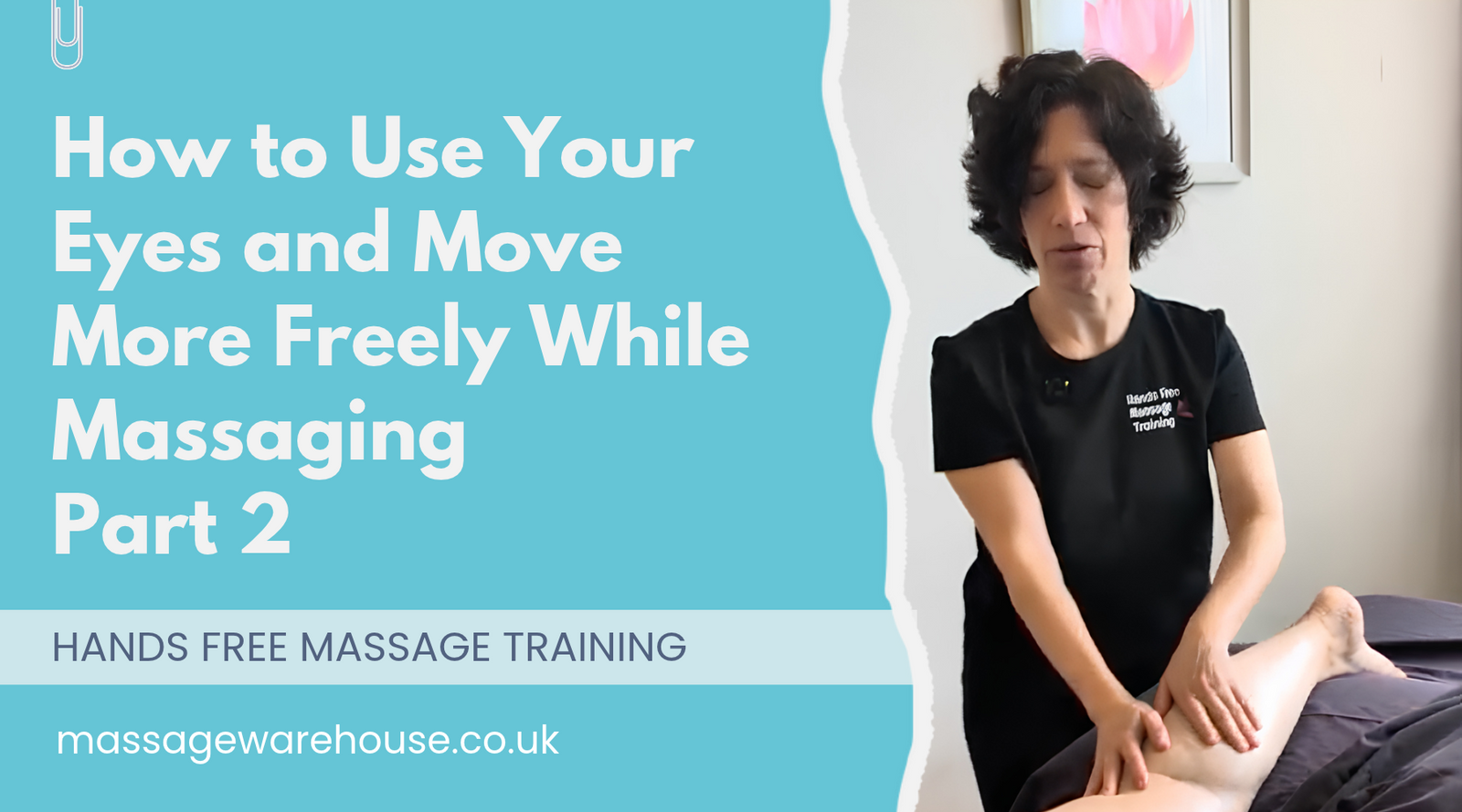
Massage therapist posture: How to use your eyes and move more freely while massaging - Part 2

Massage therapist posture: How to use your eyes and move more freely while massaging - Part 2

In Part 1 of our 4-part series, we offered you ideas around what you do with your neck, head, face and eyes while you massage. We explored what happens when we become too focused on watching our hands or forearms.

Dropping the head and hunching over can easily become a habit. Holding the head stiffly is also something to overcome. These posture-related issues affect not just the neck and back, but how freely we use our whole body.

Now, in Part 2, we offer you some options so you can try using your eyes in different ways and start to move away from lookingat what you are doing and instead build confidence to feel more, all while maintaining fluidity and softness in your body.

These practices are relevant whether you are working with hands or doing Hands Free Massage.

Shutting your eyes or defocusing

A simple way of reducing the tendency to drop your head or hunch over is to shut your eyes regularly or to defocus them during a massage, or at least to look away from what you’re doing now and then. This allows you to focus on moving your body with your hands or forearms.

It will also enable you to concentrate on your sense of touch with less distraction. You will be able to identify the client’s tensions more easily and feel the responses in their tissues as you massage.

This becomes particularly interesting when working with Hands Free Massage, where developing sensitivity through the forearms and elbows is such an important part of the learning process.

Exercise to move fluidly with your eyes shut

Bear in mind however that, even when we shut our eyes, many of us are still trying to ‘look’ through closed eyelids. This can lead back into the same problems of holding the head still and consequently also stiffening the rest of the body. You can train yourself out of this.

TRY THIS…

1. Stand at the side of the table and do a familiar effleurage stroke on your partner’s leg or back by swaying your whole body forward and back.

2. Shut your eyes and do the stroke a number of times until you’ve found a steady, relaxed rhythm for the movement.

3. Sway smoothly to and fro and you'll slowly feel that you begin to move your hands with fluidity and evenness in the movements.

4. Pay careful attention to what you are doing with your head and neck. Soften your neck muscles and keep your neck in line with your spine or even slightly undulating as you move. Your head can ‘dance’ with your body.

5. Then open your eyes and bring them back into play. If this impedes the movement and therefore the fluidity of your body, shut your eyes again and re-establish the movement. Then try opening them again. Practise this as many times as you need until you are able to move fluidly with your eyes open.

6. Then practise the same process with less familiar strokes.

The bonus? With practice, you will find that ‘switching off’ your eyes like this can also help you to tune into your hands, forearms and elbows (how you are using them and what you are feeling under them), as well as your body too. This will help you protect your hands and body while you work.


Exercise to soften your focus

TRY THIS…

1. While not massaging, focus softly on one spot while turning your head up and down and from side to side.

2. Soften your eyes. Don’t stare fixedly, as this would tend to stiffen your neck.

3. Let your focus be soft so that you can move your head easily

4. Then try this while you are massaging: keep your eyes on what you are doing, without hunching your neck or back and see if you can move your head a little as you massage, mobilising your own neck as you work

The bonus? This exercise enables you to feel how to soften and adjust your focus while also moving your neck.


Enhancing your peripheral vision while you massage

Using your peripheral vision is another way to use your eyes while you massage. This will help you stop relying on looking at your hands, which can result in bending your neck or hunching over while you massage.

Using your peripheral vision while you massage will enhance your ability to pick up movement at the edge of your field of vision.

Peripheral vision is also a very helpful massage sensory guide; You can pick up changes in breathing, facial expression or finger movements that indicate mini-reactions to the massage.

TRY THIS…

1. Stand or sit at least 1.5 - 2 metres away from a wall that is bare or has very few distracting objects on it.

2. Focus your gaze on the wall and keep your focus here throughout the exercise.

3. Lift your hands so that each one is about 30 cm to the side of your head.

4. Move them forward and back at the side of your head so that they move just in and out of the edge of your vision.

5. If you keep your focus directly ahead, you might not see the shapes of your hands clearly, but will get a sense of their movement.

6. As you move your hands, also wiggle your fingers to enhance this sensing of movement.

7. Place your hand on top of your head, move it forward so you can see your fingers appear without looking up.

In summary

In Part 2, we’ve explored some different ways of using your eyes while you massage, rather than relying on constantly watching what your hands or forearms are doing.

Closing or defocusing your eyes, softening your focus and developing your peripheral vision can all help you become more aware of what you are feeling through your hands or forearms, while also allowing your head, neck and whole body to move more freely.

The aim isn’t to stop looking altogether. It’s about becoming less dependent on your eyes and developing greater confidence in your sense of touch and your awareness of your whole body.With practice, you can begin to feel your way through more of your massage rather than needing to watch it.

These ideas can be useful whether you work primarily with your hands or with Hands Free Massage. And, as with so much in massage, the more we practise, the more natural it becomes.

In Part 3, we’ll move our attention to the face and jaw and the tension we might carry there while we massage.

Read Part 1: Watching your hands and hunching over while you massage

This article is excerpted from Dynamic Bodyuse for Effective, Strain-Free Massage (Lotus Publishing, 2008), to be republished in a new edition, Delivering Effective, Strain-Free Massage in 2026.


About the Authors

Darien Pritchard from Dynamic Massage and Hands Free Massage Training, has been a massage trainer since 1982, and has served on the General Council for Massage Therapy (UK). He wrote the career-maintenance book Dynamic Bodyuse for Effective Strain-Free Massage (2008), and the student text Anatomy, Physiology and Pathology for Massage (2nd ed, 2023). For four decades, Darien has pioneered a focus on how massage practitioners can protect their hands and body whilst using them most effectively, including developing the original Hands Free Massage training 25 years ago - the skilful, sensitive use of the forearm and elbow to save the hands.

Leora Sharp from Hands Free Massage Training, has been a massage practitioner since 2008 and very early on in her career, realised the importance of needing to work as Hands Free as possible. To that end, in 2009 she trained with Darien and was so blown away with Hands Free Massage, that she offered to assist him on his 8 Day Advanced training. Her role slowly transformed into co-teacher and she then started teaching solo in 2016. She is continually bowled over how amazing HFM is and the benefits it brings to practitioners to sustain their careers. Alongside teaching HFM, Leora has a private practice at Neal’s Yard in Bath and designs websites for complementary health professionals.


Also in Massage Warehouse Blog

Christmas Gift Ideas for Massage Therapists 2026 – Massage Warehouse

November 17, 2026 5 min read 0 Comments

Looking for Christmas gift ideas for a massage therapist? Whether you're treating yourself or buying for someone special, discover our pick of massage tables, treatment room accessories and everyday essentials to make their working day a little easier.

Read More
Autumn Budget 2026: What Does It Mean for Massage Therapists?

November 06, 2026 8 min read 0 Comments

What does the Autumn Budget 2026 mean for your massage business? We’ve picked out the key changes every self-employed massage therapist should know about, including the increase in the trading allowance, higher business mileage rates, changes to Self Assessment tax payments and Making Tax Digital. Find out what’s changing, when it’s happening and how it could affect your finances.

Read More
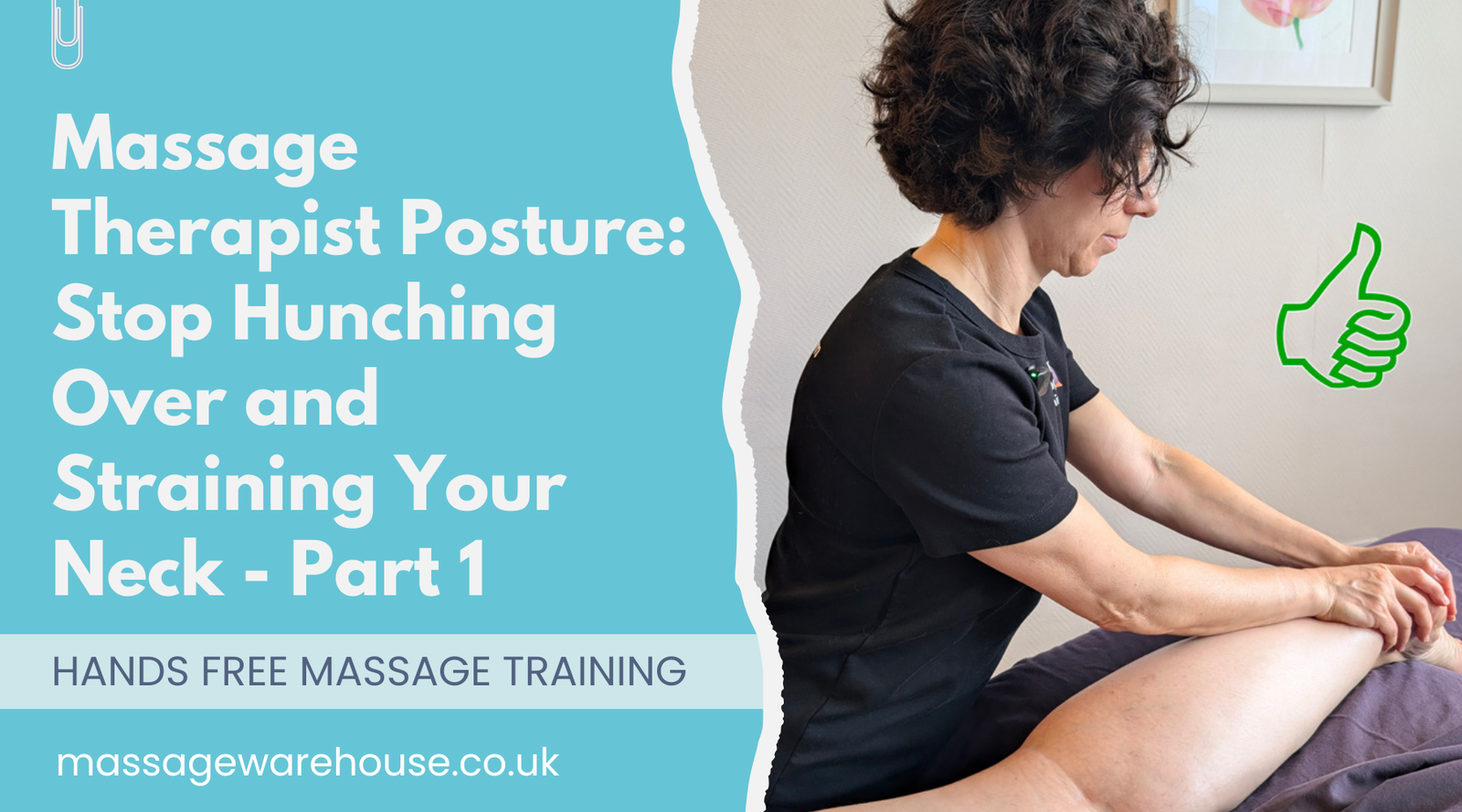
Massage therapist posture: Stop hunching over and straining your neck - Part 1

October 22, 2026 5 min read 0 Comments

Do you find yourself hunching over your massage table to watch your hands? Discover how head and neck position affect your posture, body mechanics and the way you work, plus practical tips to help massage therapists reduce strain and work more comfortably.

Read More